If your entire SEO strategy still revolves around stuffing “homes for sale in [city]” into every page title, meta description, and blog post you publish — you’re already losing. Not going to lose. Losing. Right now.
The leads you should be getting? They’re going to the agent down the street who figured out what Google actually wants in 2026. And what Google wants has nothing to do with your keyword density.
It wants to know who you are, not what words you type.
Welcome to the era of entity-based SEO — the single biggest shift in search strategy since Google killed keyword meta tags. And if you’re a real estate agent who depends on organic traffic for local leads, this isn’t optional reading. This is survival.
The Old SEO Playbook is Dead (And It’s Costing You Leads)
The Old SEO Playbook is Dead (And It’s Costing You Leads)
Here’s how most real estate agents still “do SEO” in 2026:
- Pick a keyword like “best realtor in Austin.”
- Cram it into the title tag, H1, first paragraph, alt tags, and URL slug.
- Write a 500-word blog post that says absolutely nothing a human would care about.
- Pray Google ranks it.
Sound familiar?
That playbook worked in 2015. Maybe even 2019. But Google’s algorithm has undergone a fundamental transformation since then. It no longer matches strings of characters to web pages. It matches meaning to entities.
Google’s own engineers have said it plainly: the search engine now understands “things, not strings.”
That phrase isn’t a cute slogan. It’s the architecture of modern search. Google uses Natural Language Processing (NLP) and semantic search to understand the intent behind a query, the relationships between concepts, and the identity of the businesses and people behind websites.
So when someone types “top real estate agent near me,” Google doesn’t just scan for pages containing those exact words.
It asks: Who is a verified, trusted real estate professional in this searcher’s geographic area? What does the web collectively say about them? How confident am I that this person is a real, authoritative entity — not just a keyword-stuffed webpage?
If Google can’t answer those questions about you, you don’t exist. Not in the way that matters.
And that’s exactly why your phone isn’t ringing.
What the Hell is an “Entity” Anyway? (Explained for Humans)
Forget the technical jargon for a second. Let me make this dead simple.
FAQ : What is entity-based SEO?
Entity-based SEO is the practice of establishing yourself as a recognized, unique “thing” in Google’s understanding of the world — not just a collection of keywords on a webpage. It involves building consistent identity signals across the web so search engines can confidently connect you to relevant local queries.
Think of it this way.
You are an entity. Your brokerage is an entity. The neighborhood you farm is an entity. The city you work in is an entity. Even “luxury condos” is an entity.
An entity is any distinct, well-defined thing that Google can identify, categorize, and relate to other things. A person. A place. A business. A concept.
Google stores these entities and their semantic relationships in a massive database called the Knowledge Graph. Right now, the Knowledge Graph contains billions of entities and trillions of connections between them.
Here’s the kicker: Google doesn’t need your website to know about an entity. It pulls data from your Google Business Profile, Wikipedia, social media accounts, local directories, government records, news articles — anywhere your name, business, and information appear.
This process is called entity extraction — Google’s ability to pull structured meaning out of unstructured data scattered across the web.
So entity-based SEO isn’t about tricking an algorithm. It’s about making Google certain about who you are, what you do, and where you do it.
It’s about disambiguation — helping Google distinguish you from every other “Sarah Johnson” or “Premier Realty Group” on the planet.
When Google is confident you are a distinct, trustworthy entity connected to a specific location and service? That’s when leads start flowing. That’s when you show up in the Knowledge Panel, the Local 3-Pack, the AI-generated answers.
When Google isn’t confident? You’re invisible.
How Google’s Knowledge Graph Decides Who Gets the Leads
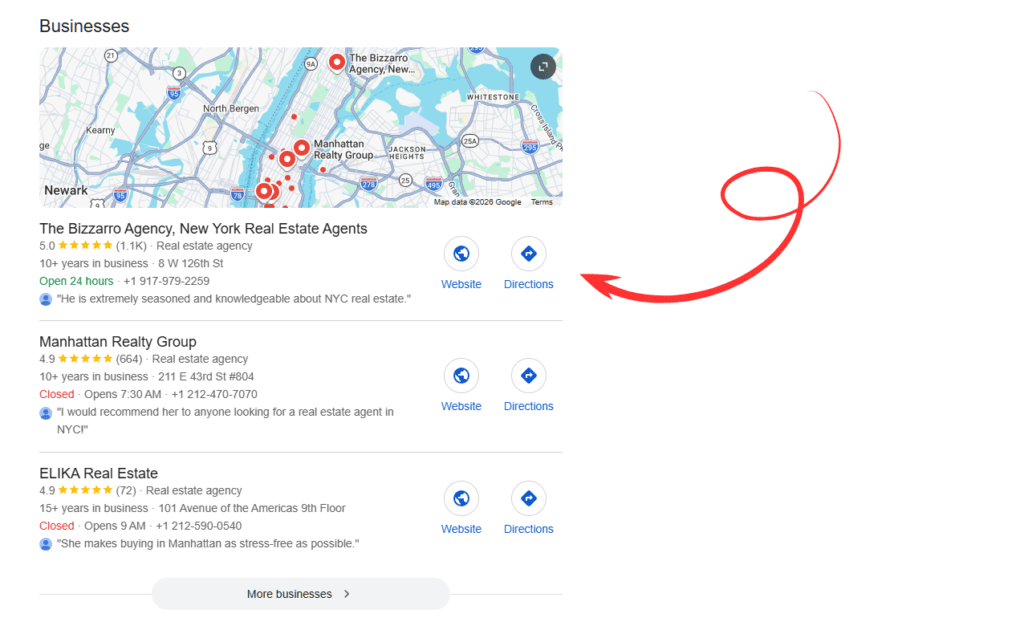
Let’s pull back the curtain on what actually happens when someone searches “real estate agent in Scottsdale” in 2026.
Google doesn’t just crawl websites anymore. It runs the query through multiple layers of understanding:
Layer 1: Intent Recognition. Using NLP, Google determines the searcher wants a local service provider — not a Wikipedia article about real estate, not a Zillow listing, not a news article. This triggers local results.
Layer 2: Entity Matching. Google searches its Knowledge Graph for entities that match the criteria: type = real estate agent, location = Scottsdale, AZ. It looks for entities it has high confidence in — meaning entities with strong, consistent signals across multiple sources.
Layer 3: Entity Salience Scoring. Not all entities are equal. Google assigns an entity salience score — basically, how important and relevant a particular entity is to the query’s context. An agent with deep connections to Scottsdale-related content, local organizations, and neighborhood-level data scores higher than an agent with a generic “I serve all of Arizona” page.
Layer 4: E-E-A-T Evaluation. Google assesses Experience, Expertise, Authoritativeness, and Trustworthiness. Does this agent have real reviews from Scottsdale clients? Have they published content demonstrating genuine local knowledge? Are they cited by local news outlets or community organizations? The contextual relevance of these signals matters enormously.
Layer 5: Proximity & Local Signals. Finally, factors like proximity to the searcher, NAP consistency (Name, Address, Phone number across the web), and the strength of local citations determine which entities land in the coveted Map Pack — those top three local results that capture the lion’s share of clicks.
This entire process happens in milliseconds. And at no point does Google say, “Let me check who stuffed the most keywords into their homepage.”
It’s all about entity confidence. Semantic relationships. Verified identity.
The agents who understand this are building empires. The agents who don’t are writing their 47th blog post titled “5 Tips for First-Time Homebuyers” and wondering why nobody reads it.
3 Steps to Build Your “Local Entity” Empire (And Dominate 2026)
I’m going to walk you through exactly how a real estate agent can build a bulletproof local entity — with a real-world framework you can steal and adapt today.
Step 1: Hyper-Optimize Your Google Business Profile (The Core Entity)
Your Google Business Profile is the single most important asset in your entity-based SEO strategy. Full stop.
It’s not a “nice to have.” It’s the foundation of your digital identity.
FAQ : Why is Google Business Profile important for real estate agents?
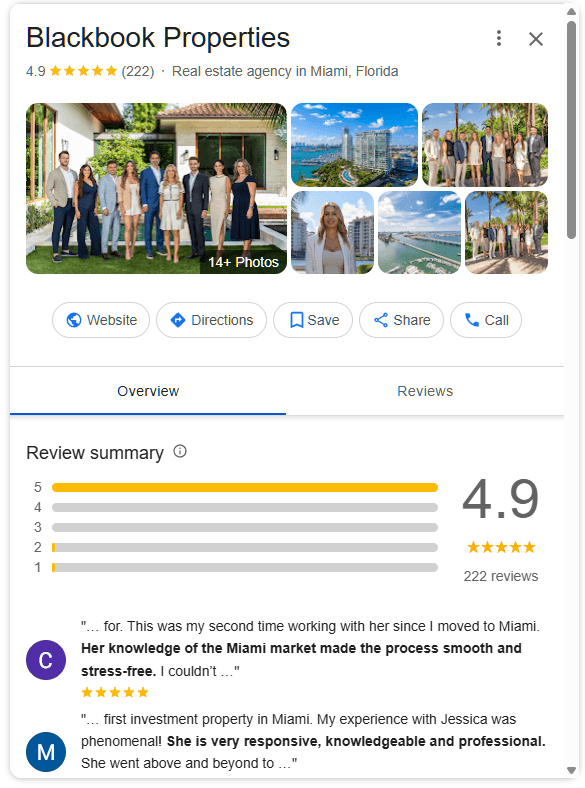
Your Google Business Profile is the primary data source Google uses to verify your identity, location, and services as a local entity. A fully optimized GBP directly influences your visibility in the Local 3-Pack, Maps, and AI-generated local results — where the highest-intent buyer and seller leads search first.
Here’s how to optimize it like you mean it:
- Claim and verify your profile if you haven’t already. Sounds obvious. You’d be shocked how many agents skip this.
- Nail your NAP consistency. Your business name, address, and phone number must be identical everywhere — your GBP, your website, your brokerage page, every single directory. One inconsistency and Google’s confidence in your entity drops.
- Select precise categories. “Real Estate Agent” as your primary category. Add secondary categories like “Real Estate Consultant” or “Property Management Company” only if they genuinely apply.
- Write a keyword-rich, entity-rich description. Don’t just say “I help people buy and sell homes.” Say: “Jane Martinez is a licensed real estate agent specializing in luxury waterfront properties in Clearwater, FL. Serving Belleair, Sand Key, and Clearwater Beach since 2014.” — This creates the semantic relationships Google’s Knowledge Graph is actually looking for.
- Add real photos weekly. Geotagged photos of listings, open houses, closings, and local landmarks signal to Google that you’re active and physically present in your service area.
- Collect and respond to reviews relentlessly. Reviews are entity-validation signals. They tell Google real humans in your area interact with your business. Respond to every single one — it demonstrates engagement and builds topical authority within your local market.
- Use the Q&A and Posts features. These are free content slots where you can reinforce your connection to local entities (neighborhoods, landmarks, events, market conditions).
Implement Real Estate Schema Markup on your website that mirrors your GBP data. Use structured data specifically LocalBusiness and RealEstateAgent schema to explicitly tell Google: “This website belongs to the same entity as this Google Business Profile.” This is how you create an unbreakable link between your online properties and your Knowledge Graph entry.
If you have an IDX integration on your site, make sure your listing pages also carry proper schema markup — connecting property entities to your agent entity and their location entities.
This is the foundation. Without it, nothing else matters.
Step 2: Build Unbreakable Local Connections (Citations & Backlinks)
Once your GBP is locked in, you need to surround your entity with a web of local citations and backlinks that scream, “This person is a REAL part of this community.”
FAQ: How to do entity SEO for a local business?
Start by claiming consistent business listings across top directories (Yelp, Realtor.com, Zillow, BBB), then earn backlinks from local organizations, news outlets, and community sites. Combine this with structured data markup on your website to create a dense network of signals that validates your entity in Google’s Knowledge Graph.
Let’s say you’re an agent operating in Boulder, CO. Here is exactly how you build your local entity connection:
Local Citations (Consistency is King):
- Claim your profile on Realtor.com, Zillow, Homes.com, Yelp, BBB, and the Boulder Chamber of Commerce — using the exact same business name, address, and phone number on every single one.
- List yourself on niche directories like your local MLS public site, the Colorado Association of Realtors, and NeighborhoodScout.
- Create profiles on data aggregators (Neustar/Localeze, Data Axle, Foursquare) that feed information to hundreds of smaller directories automatically.
Every one of these listings is a citation that reinforces Google’s confidence. The more consistent these are, the higher your entity salience for Boulder-related real estate queries.
Local Link Building (Authority is Queen):
- Sponsor a local 5K run in Boulder and get a backlink from the event’s website. That link connects your entity to a Boulder community entity.
- Write a guest column for the Boulder Daily Camera about the local housing market. A backlink from a trusted local news source is gold for E-E-A-T.
- Partner with a local mortgage broker and a home inspector, and cross-link each other’s websites. Google sees these semantic relationships and strengthens all of them.
- Get listed on the “preferred vendors” page of local relocation companies.
Notice what you are not doing here? You aren’t buying 500 spammy backlinks from an overseas freelancer. You aren’t submitting to random “top 100 business directories” that have zero local relevance. You are building real relationships with real local entities.
Local Link Building (Authority is Queen):
- She sponsors a local 5K run in Boulder and gets a backlink from the event’s website. That link connects her entity to a Boulder community entity.
- She writes a guest column for the Boulder Daily Camera about the local housing market. A backlink from a trusted local news source is gold for E-E-A-T.
- She partners with a local mortgage broker and a home inspector, and they cross-link each other’s websites. Google sees these semantic relationships between related local service entities and strengthens all of them.
- She gets listed on the “preferred vendors” page of three local relocation companies. These are contextually relevant backlinks from entities in related industries — exactly what Google’s algorithms reward.
Notice what Sarah is not doing? She’s not buying 500 spammy backlinks from a freelancer overseas. She’s not submitting to random “top 100 business directories” that have zero local relevance.
She’s building real relationships with real local entities. And Google sees every single connection.
Pro tip: Use geo-grid tracking tools to monitor exactly where you rank in the Map Pack across different points in your city. This reveals geographic weak spots in your entity’s local authority — areas where you need more citations, more content, or more community connections.
Step 3: Write Content That Proves Local Expertise (Not Generic Trash)
Content is still critical in 2026. But the type of content that moves the needle has changed completely.
Google doesn’t need another “How to Stage Your Home for Sale” article. There are 47 million of those. You add zero value by publishing the 47-million-and-first.
What Google does reward is hyper-local content that demonstrates genuine, on-the-ground expertise no AI tool or national brand can replicate.
This is where you build topical authority — not over “real estate” as a broad concept, but over your specific market, your specific neighborhoods, your specific buyer and seller personas.
Here’s what that looks like in practice:
Neighborhood Deep Dives. Don’t write “Best Neighborhoods in Denver.” Write “Living in Washington Park: 2026 Home Prices, School Ratings, and What Locals Actually Think.” That’s a piece of content built around multiple local entities — a neighborhood, its schools, its demographics, its price trends. Google’s NLP engine parses this and connects YOUR entity to all of those local entities. Your entity salience for “Washington Park real estate” skyrockets.
Local Market Reports. Publish monthly or quarterly data analyses for your specific area. Use actual MLS data. Include charts. Name specific streets and subdivisions. This is content that a generic national site cannot produce — and Google knows it.
“Best Of” Local Resource Guides. Write about the best coffee shops near a specific development, the best schools in a specific zip code, the best parks for families in a specific suburb. Every local business and landmark you mention is an entity. Every connection you draw between those entities and your content strengthens your semantic footprint.
Community Event Coverage. Cover local festivals, charity events, city council decisions about zoning — anything that proves you live and breathe this market. This is geo-farming at the content level, and it’s devastatingly effective.
Use long-tail localized keywords naturally within this content. Phrases like “mid-century modern homes in North Park Hill under $600K” or “new construction condos near Boulder Pearl Street” aren’t just keywords — they’re entity-rich queries that connect you to specific locations, property types, and buyer intents.
If you run a Service Area Business that covers multiple cities or regions, create dedicated landing pages for each area — each one rich with local entities, local data, and local schema markup. Don’t just swap out the city name on a template. Google’s NLP is way too sophisticated for that trick. It detects thin, duplicated content instantly and it will punish you for it.
The Google NLP API is publicly available, by the way. You can literally run your content through it to see which entities Google extracts and how salient they are. If your “local” blog post about a neighborhood returns zero local entities with high salience? Rewrite it. You’re not local enough.
Geo-targeting your content strategy this precisely is what separates agents who dominate their market from agents who blend into the noise.
The Bottom Line: Be a Brand, Not a Keyword
Entity-based SEO isn’t just another tactic. It’s a fundamental shift in how you think about your online presence.
You’re not optimizing pages. You’re building an identity.
You’re not chasing rankings. You’re earning recognition.
You’re not targeting keywords. You’re becoming a verified, trusted, locally connected entity that Google wants to recommend — because it’s confident you’re the real deal.
The agents who will win in 2026 and beyond are the ones who stop thinking like keyword-stuffing SEOs and start thinking like brand builders. They’ll invest in their Google Business Profile. They’ll build genuine local connections. They’ll publish content that no AI and no national brand can replicate. They’ll use structured data and schema markup to speak Google’s language fluently.
And the agents who keep doing what they did in 2018?
They’ll keep wondering why the leads dried up.
Don’t be that agent. Start building your entity today. Your future pipeline depends on it.
Ready to stop chasing keywords and start building your local entity? Audit your Google Business Profile, clean up your NAP consistency across every citation, publish one genuinely hyper-local content piece this week, and run your website through Google’s NLP API. That’s your starting line. Go.